Resources · Playbook
A weekly GEO routine for a small marketing team
6 min read · updated September 9, 2026

A weekly GEO review gives your team a regular time to check how AI answers describe the business and decide whether anything needs attention. Give it one owner and a stable set of buyer questions. Some weeks will produce a correction or a new content brief. Others will end with a decision to keep observing.
This routine is for a team whose content, SEO and PR work is handled by a few people, sometimes the same person. It follows our practical GEO starting guide. The goal is to keep the work manageable after the initial audit.
Why review weekly?
In MarTech's discussion of GEO as a weekly job, Shama Hyder describes bringing PR, SEO and content around a shared view of buyer prompts and cited sources. That is a useful operating model. It is an agency perspective, not evidence that a seven-day schedule causes better AI visibility.
Use a weekly slot because it gives your team a predictable place to examine new evidence. A quiet week can end with no change. A serious factual error or broken page can need attention sooner.
Before the meeting: keep one evidence log
Begin with a small, fixed set of questions that matter to buyers. Use the wording you can support from enquiries, sales conversations or other first-party research. Our buyer-prompt guide explains how to choose the questions.
For each observation, save the exact prompt, engine and mode, date, relevant location or language, answer text and cited URLs. Note whether the answer names your business and whether the description is correct. Record repeat runs rather than keeping only the best answer.
Add a separate change log for your own work: which page changed, what changed, who checked it and when it became public. Keep those dates separate from observation dates. A new answer after an edit is a sequence of events, not proof that the edit caused it.
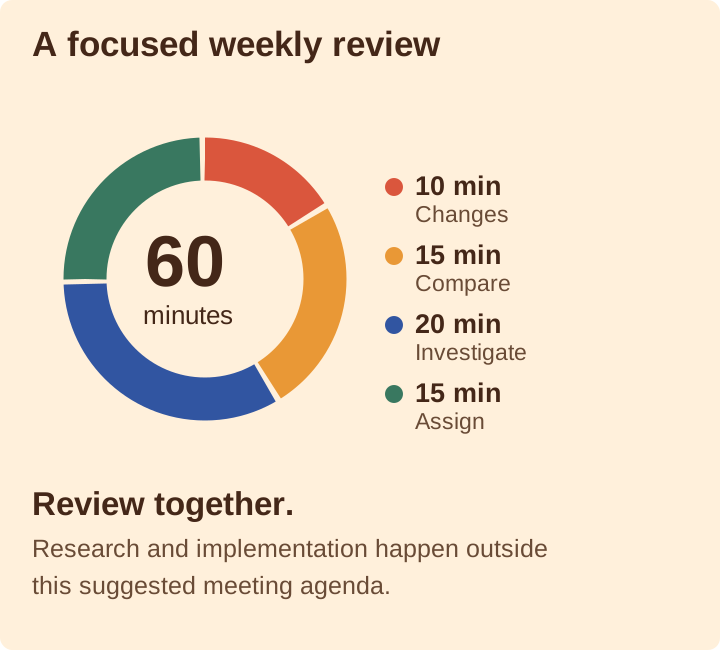
First 10 minutes: check what actually changed
Start with your business. Did a price, product limitation, integration, service area or policy change? Is the public information still correct? These checks can produce useful work even when AI visibility is unchanged.
Then review platform announcements that affect something you do. Google's 2026 website-owner update introduced reporting and participation controls. That deserves a check of your reporting process. A new model name alone does not tell you which paragraph to rewrite.
Keep a short source list and record dates. Prefer a provider's current documentation for how its feature works, and distinguish that from a consultant's recommendation about how to organize your team.
Next 15 minutes: compare the same observations
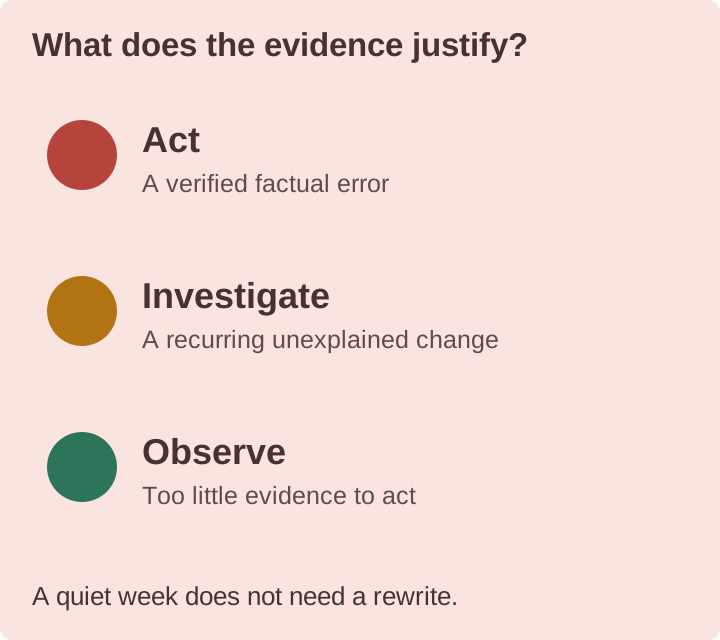
Review the saved answers against the previous period. Look for a recurring factual error, a newly cited page or a repeated absence on a commercially relevant question. Avoid turning one changed answer into an emergency.
Read platform metrics separately from your sample. Our AI traffic measurement guide keeps impressions, citations, visits and enquiries distinct. If a reporting definition changed, annotate the comparison before discussing performance.
When answers differ, ask whether the observation conditions differed too. A changed prompt, language, mode or location can make a comparison unhelpful. Retain the old prompt set while you test a new question alongside it.
Spend 20 minutes investigating one useful issue
Choose an issue whose resolution would help a buyer. Open the actual source cited in the answer. Check what it says now. Compare it with your product or service documentation, then identify who can correct the underlying information.
Suppose, hypothetically, an assistant says your service includes weekend support when it does not. If your own pricing page is ambiguous, improve that page. If an independent directory is wrong, prepare a factual correction for its owner. If the cited pages are accurate, record the mismatch rather than blaming a source without evidence.
PR, content and technical work can follow from the same issue, but they are different tasks. Sending more pitches does not fix a blocked page. Adding schema does not correct an unsupported pricing claim.
Final 15 minutes: assign work or leave it alone
Write a task that someone can finish and another person can check. “Improve GEO” is not a task. “Clarify weekend support on the pricing page and check the published wording” is.
Give each action an owner, a completion check and a later observation date. Keep the deliverable distinct from the hoped-for outcome. You can verify that a correction was published; you cannot promise when an assistant will use it.
For content work, ask what original information the page adds. Google's people-first content guidance encourages self-assessment of usefulness and originality. A rewritten introduction with no new answer is a weak reason to consume the week's writing time.
Use a short weekly note
This is a hypothetical example, not a Geofound customer result:
- Observed: two saved answers describe weekend support incorrectly.
- Checked: the current pricing page does not explain support hours clearly.
- Decision: add the actual hours and clarify the exceptions.
- Owner: the person responsible for the pricing page.
- Completion check: review the live page against the support policy.
- Follow-up: repeat the same questions at the next review; do not promise a changed answer.
Keep the full answers linked from the note. Anyone should be able to see why the task was chosen without trusting a summary alone.
What can wait for a less frequent review?
A broad content inventory, a tool comparison or a redesign of the prompt set usually needs more attention than a weekly meeting permits. Schedule that work separately when the evidence justifies it. Reconsider the cadence if the review produces repetitive notes and no useful decisions.
Must we publish weekly? No. Publish when you have a useful answer, evidence and a reason for a new page. Correct an existing page when that is the right home for the information.
Should every visibility drop trigger a rewrite? No. Preserve the observations, check conditions and investigate repeated patterns. Our guide to visibility scores gives the measurement context.
Start with a brand visibility scan and save the evidence. At the next review, decide what needs a correction, what needs investigation and what can wait.
Citations (3)showhide
See who AI recommends in your category
The free scan asks ChatGPT three of your buyers' questions and shows whether you're in the answer, in about a minute.
Run the free scan →