Resources · Playbook
GEO in 2026: a practical guide for small teams
6 min read · updated September 9, 2026

Start your GEO work with a question a buyer needs answered. If your website leaves that question unresolved, you have a concrete place to begin.
Generative engine optimization, or GEO, means working on how your business appears in answers generated by AI systems. That includes whether an answer mentions you, links to your material and describes your offer accurately. These are useful things to examine. They are also different from someone visiting your website or becoming a customer.
For a founder or marketing lead, the first decision is where to put limited time. Start with a few pages that help buyers choose, check whether search systems can access them, and measure what happens. A large new publishing programme can wait.
Keep SEO in the plan
GEO gives you another way to assess your content. Keep the search work that helps people find and understand it.
Google says SEO still applies. Eligibility requires indexing, snippet eligibility and Search generative AI inclusion. It requires no special schema, chunk length or llms.txt file. That guidance is specific to Google. Google’s AI optimization guide.
Search generative AI inclusion is enabled by default for top-level properties, with child properties inheriting settings. Check your configuration before treating this as a new opt-in task. Google’s inclusion controls.
For your team, the practical implication is a shared backlog. If an important service page contains an outdated price, fix it. If a comparison omits a material limitation, add it. If a page cannot be indexed, investigate before commissioning five supporting articles.
Choose work that makes the website more useful even if its appearance in AI answers does not change. That gives a small business a defensible reason to invest without needing a citation forecast.
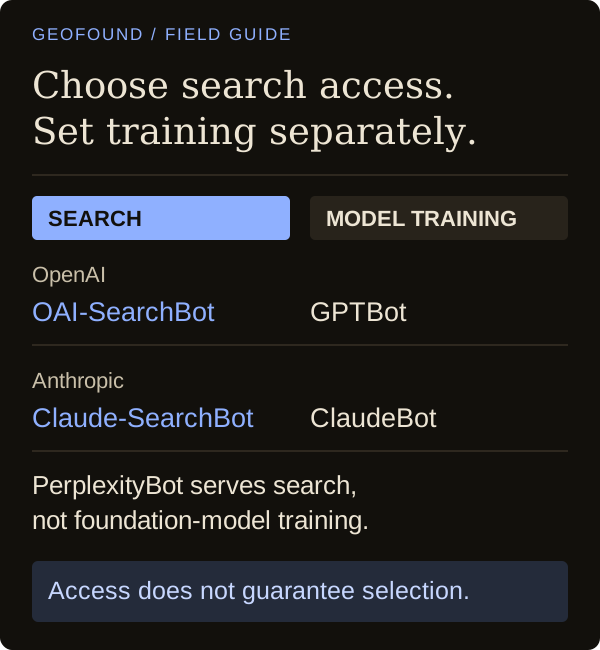
Separate search access from training access
Before editing crawler rules, write down what you want to allow. “Block AI” is too broad a brief for someone changing access settings.
OpenAI distinguishes OAI-SearchBot for ChatGPT search from GPTBot for training. The controls are independent; allowing search access does not guarantee selection. OpenAI’s bot documentation.
PerplexityBot supports search results rather than foundation-model training. Its guidance includes published crawler IPs and firewall configuration alongside robots.txt. Perplexity’s crawler documentation.
Anthropic distinguishes Claude-SearchBot for search, ClaudeBot for training and Claude-User for user-directed retrieval. Anthropic’s crawler guidance.
Give whoever maintains your site a short access brief: which search crawlers you intend to admit, your separate position on training, and the pages to check. Ask them to inspect both the site rules and the security configuration, then document the result.
Treat permission and visibility as separate checks. An accessible page still needs useful material, and you still need observations to establish whether an answer uses it.
Publish evidence that helps someone choose
Start with a question a buyer has actually asked. Sales emails, support requests and objections raised in conversations can supply candidates. Choose a question where your existing answer is incomplete and where a better answer would help someone make a decision.
Suppose, hypothetically, you sell booking software to independent clinics. “The future of appointment management” is a broad writing assignment. “Can we move recurring appointments without losing their assigned practitioner?” gives the writer a specific problem to resolve.
A useful page could explain the supported process, the information a customer must supply, the cases that require manual work and who should check the result. Include a worked example only if it reflects the product. Label a hypothetical example clearly.
Evidence needs enough context to be judged. For an actual test, state what you tested, when, how and with what limitations. If an author has relevant credentials, describe the real credentials. If a result applies only to one configuration, keep that boundary next to the result.
This can mean publishing fewer claims. A candid explanation of an unsupported use case may help a buyer more than another paragraph promising flexibility. It also gives your team a precise statement to check when reviewing AI answers about the product.
Decide what you are measuring before collecting it
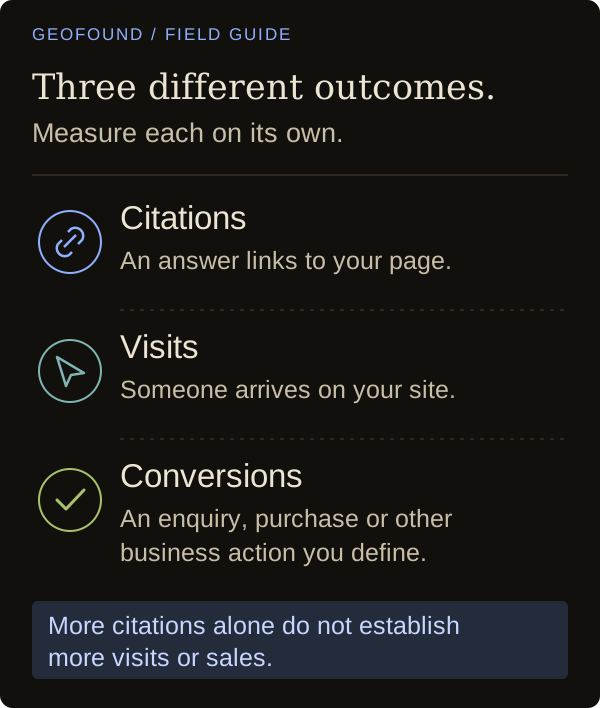
Keep three outcomes separate:
- Citations: an answer links to your material.
- Visits: someone reaches your website through an observable referral.
- Conversions: someone completes a defined business action, such as an enquiry or purchase.
Track unlinked brand mentions and accurate recommendations separately too. A mention with an incorrect description needs attention even when the visibility count looks encouraging.
Google Search Console documents a Generative AI performance report for AI Overviews and AI Mode impressions, with page, country and device views. It is not a cross-platform citation report or a dedicated conversion report. Google’s report documentation.
Bing announced AI Performance in public preview in February 2026. It reports citations across supported Microsoft experiences and selected partners; counts do not establish placement, authority or ranking. Bing’s announcement.
Use those reports within their stated scope. Alongside them, keep a small, fixed sample of buyer questions for manual checks. Record the engine, mode, date, location and raw response. Repeat the observations rather than selecting the answer that best supports your expectations.
Label the findings as results from that sample. Ten questions do not describe every buyer’s experience. A changed answer after a page edit does not establish that the edit caused it.
Use your analytics to examine observable referral visits and business outcomes, acknowledging missing attribution. Avoid combining all of these measures into a single success score. You need to see whether the problem is absence, inaccurate information or a lack of useful customer activity.
Give a small team a four-week starting plan
Use four weeks to organize the work and review your observations. It is not a deadline for improved visibility; you may need a longer observation period.
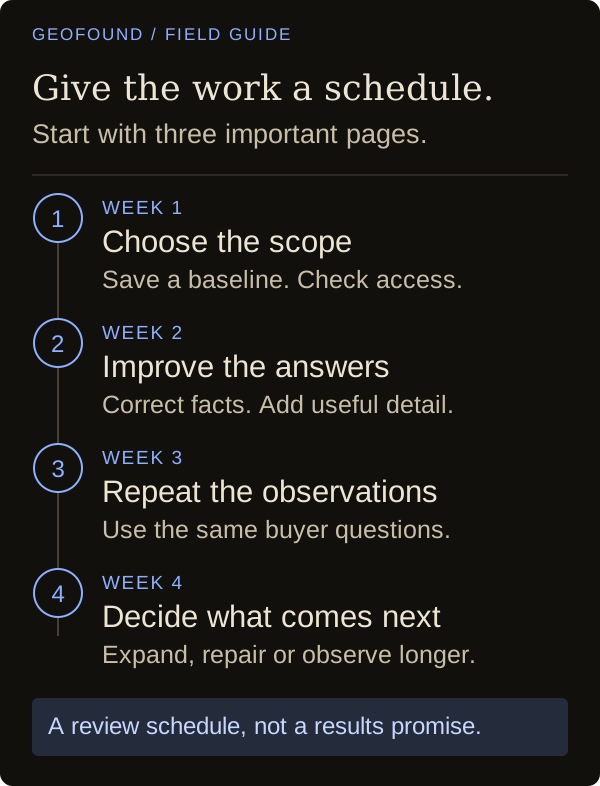
Week one: choose the scope. Pick three important pages and a manageable set of buyer questions. Save the current answers from your selected engines. Record factual errors, mentions and links separately. Complete the access checks and note any unresolved issue.
Week two: improve the answers. Correct inaccuracies first. Then address a specific gap on each page: a missing limitation, an unclear process or an unsupported claim. Record each change and its date. Have someone who knows the product check the substance before publication.
Week three: repeat the observations. Use the same questions and record the same context. Review the relevant platform reports and observable referrals. If results differ, describe the difference without assigning a cause you cannot demonstrate.
Week four: make a resource decision. Expand only if you can name the next useful content gap and explain why filling it deserves time. If access remains unresolved or descriptions are still wrong, keep the scope small and address those problems first.
The decision is whether the next piece of work will help buyers and produce something you can evaluate. A clearer, accurate page is a concrete deliverable. Citations, rankings and revenue remain outcomes to observe, with no guarantee attached.
Citations (7)showhide
See who AI recommends in your category
The free scan asks ChatGPT three of your buyers' questions and shows whether you're in the answer, in about a minute.
Run the free scan →