Resources · Strategy
SEO vs GEO and AEO: why AI visibility does not follow your rankings
9 min read · updated August 27, 2026
Two documents published this year give opposite advice about AI visibility, and both are worth taking seriously. Google's AI optimization guide says there is no such thing as optimizing for AI separately, because its generative features run on the same ranking systems as classic search. Jessica Bowman's piece in Search Engine Land says search engine optimization is only half the job, and the half that decides whether an assistant recommends you often sits outside the marketing team entirely. They cannot both be complete descriptions of how generative engine optimization works. We track this for a living, so we went looking for who the evidence supports.
The short version: SEO is a real input to AI search visibility, and it is not the same discipline. Treating GEO and AEO as a rebranded version of your existing search program is the most common expensive mistake we see.
What Google actually claims
Google's position on generative engine optimization is unusually blunt. AI Overviews and AI Mode are built on core Search ranking and quality systems, so the standard search engine optimization playbook is the whole job. The guide then lists the things it says do not work, and the list is longer than most people expect. Google Search ignores llms.txt and other AI text files. Structured data is not required for generative AI search. Chunking your content into small pieces is unnecessary. Rewriting pages specifically for language models does nothing, because the systems already handle synonyms and context. Chasing manufactured product mentions across the web is not an effective AI visibility strategy.
Read literally, that guidance retires most of what the answer engine optimization industry sells. If you already do technical SEO well, publish content people want, and stay crawlable, Google says you are done.
There is one detail worth holding onto. That page governs Google's own answer surfaces and nothing else. AI Overviews and AI Mode are two of the eight generative engines a buyer might use. ChatGPT, Claude, Perplexity, Gemini, Grok and ChatGPT Shopping retrieve, rank and cite by their own rules, and Google has no authority over any of them.
What Bowman argues instead
Bowman's argument starts from a gap most search engine optimization frameworks have no name for. Being mentioned by an AI assistant is not the same as being recommended by one. A brand can have clean technical SEO, genuinely good content and steady citations, and still get dropped the moment the assistant stops summarizing a topic and starts advising a purchase.
Her explanation is uncomfortable. Sometimes you lose the AI recommendation because the model read your product accurately. It found the maintenance burden, the missing integration, the support complaints, the capability you do not have. No amount of answer-shaped content fixes a product that is genuinely behind, and no GEO consultant can write their way around it. The people who can fix it work in Product, Support, Finance and Design. So the search team's real job becomes diagnosis plus internal persuasion, which she frames as owning the program while other teams own the solution.
Google's guide has no category for this. Every remedy it offers is a content remedy or a crawling remedy. The case where the machine is simply right about you does not appear.
Side by side, the two positions barely overlap:
| Question                          | Google's guide            | Bowman, Search Engine Land   |
|-----------------------------------|---------------------------|------------------------------|
| Is SEO enough for AI visibility?   | Yes, it is the whole job  | No, it is the floor          |
| Where does the fix live?           | Content and crawling      | Often Product or Support     |
| Can AI be right that you are worse?| Not addressed             | Yes, and that is the point   |
| Who owns the work?                 | The search team           | Search diagnoses, others fix |
| Which engines does it cover?       | Google surfaces only      | AI recommendation generally  |
The data does not support either one cleanly
This is where it gets interesting, because a third source contradicts both. Ahrefs studied 75,000 brands and measured which signals track with appearing in AI Overviews. If Google's framing were the whole story, the classic search engine optimization metrics would lead. They do not.
Ahrefs, Spearman correlation against AI Overview brand mentions. The authors state plainly that correlation is not causation and that every factor they measured came out moderate to very weak. Read it as a ranking of signals, not a formula.
Backlinks came last. The single currency that classic SEO has optimized for since 2000 sits at the bottom of the list, at roughly a third of the correlation of plain branded mentions on other people's pages. Domain Rating, the metric agencies put on slide one of every pitch, lands mid table. What leads is being talked about by name, in text, on sites you do not own.
That result cuts against Google and against traditional search optimization at the same time. It undercuts the link-first orthodoxy that AEO inherited from SEO. It also sits awkwardly beside Google's line that seeking product mentions across the web is not effective, because unlinked brand mentions are the strongest thing anyone has measured. The two claims can be reconciled, since Google warns specifically against manufactured mentions and the study measured organic ones, but the practical advice a marketer takes from each is close to opposite.
Hold the Ahrefs caveat in view, though. The authors say directly that correlation is not causation and that all their coefficients were moderate at best. Brands with more mentions also tend to be bigger, older and better funded. Nobody has isolated the mechanism.
Three more places the advice contradicts itself
The llms.txt argument is the cleanest example. Google says its Search systems ignore the file completely. Much of the generative engine optimization industry still recommends publishing one, and the agent tooling world has been adopting it for a different purpose entirely. Both can be true because they are describing different systems. A file that does nothing for Google AI Overviews may still matter in the agentic layer where assistants fetch context to complete a task. The advice only looks contradictory when you forget to ask which engine anyone is talking about.
Structured data splits the same way. Google says schema markup is not required for its generative AI search features. Most AEO practitioners treat JSON-LD as foundational. Notice that Google said not required, which is a different claim from does not help. Machine readability and ranking necessity are separate questions, and the guide only answered one of them.
Then there is recency. Classic SEO rewards evergreen content that accrues authority over years. Answer engines lean noticeably toward fresh material, and a page that was cited constantly in spring can quietly stop being cited by autumn without losing a single ranking position. If your GEO reporting is a rank tracker with a new label, you will not see that happen.
Why the engines disagree with each other too
Underneath all of this sits a fact that makes universal AI search advice suspect. The engines are built differently. Google AI Overviews draw on the Google index. ChatGPT's search leans on a different index entirely. Perplexity runs its own live retrieval. Claude, Gemini and Grok each apply their own reranking and citation behavior on top.
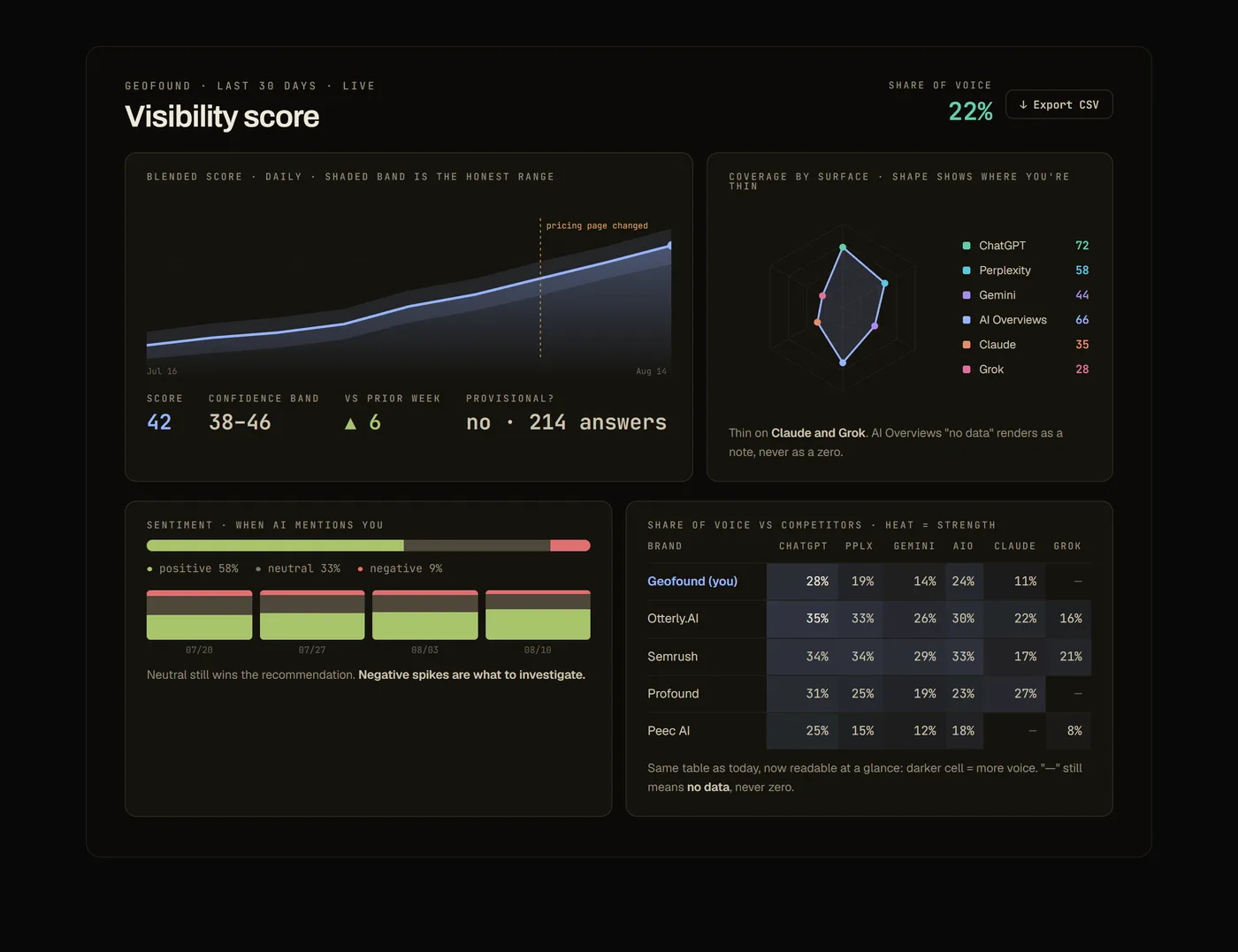
So the same intervention produces different results depending on the surface, and any single number describing "AI visibility" is an average across systems that do not agree. This is why we sample repeatedly across engines rather than checking once, and why our visibility scores ship with confidence bands instead of a tidy figure. A single-number AI visibility score with no uncertainty attached is a marketing artifact, not a measurement.
The proof that crawlable does not mean recommended
Here is the cleanest evidence that AI visibility is its own discipline, and it comes from the same Ahrefs dataset. To qualify for the study a brand needed a Domain Rating above 40 and a keyword pulling at least 800 searches a month. These are not obscure sites. They are companies that already won at search engine optimization.
Roughly a quarter of them were named zero times in AI Overviews.
Ahrefs, 75,000 brands filtered to Domain Rating above 40 with a keyword at 800 or more monthly searches. Around 26 percent recorded no AI Overview mentions at all. Passing every classic SEO test does not put you in the answer.
Sit with that number. One in four brands with real domain authority, real rankings and real search traffic gets named zero times by the AI layer sitting on top of the index they rank in. Their SEO works. Their generative engine optimization does not exist. If AI search visibility followed rankings, that group would be close to empty.
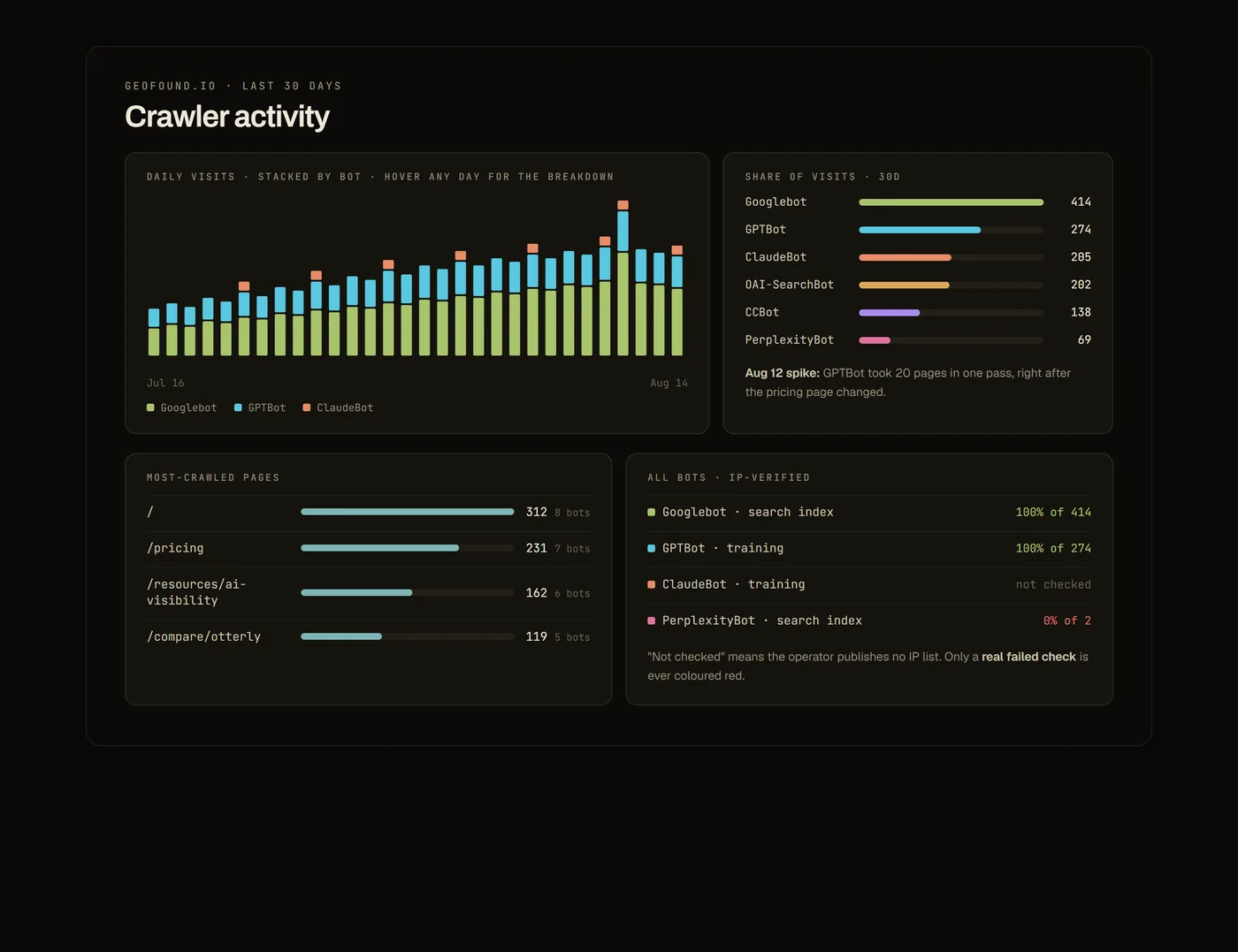
Crawl data is where most teams stop, and it is worth being precise about what it proves. Confirming that GPTBot, ClaudeBot and Googlebot fetch your pages and get a 200 tells you the door is open. It says nothing about whether you get recommended once they are inside. Both of those are worth measuring, and confusing them is how brands end up reporting healthy AI crawler traffic while losing every buyer question in their category.
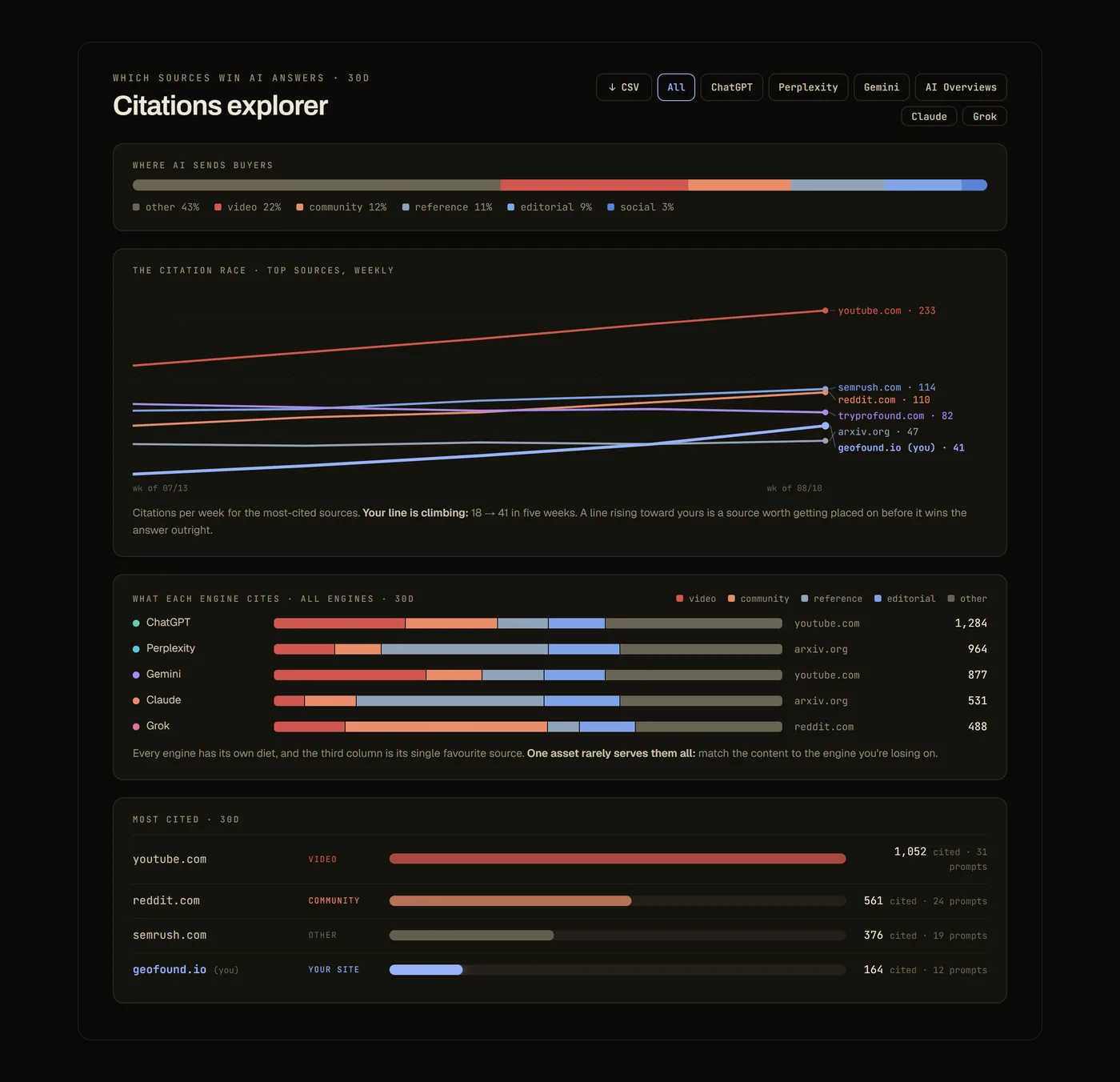
The more useful question is which sources the answer engines actually quote in your category, because that is where the correlation data points. If assistants keep citing three review platforms and a community thread when they answer your buyers' questions, those four pages are your GEO roadmap. It is unglamorous, and it is closer to public relations and partnerships than to technical SEO.
So what should you actually do
Here is the answer, given that the authorities disagree.
Do the search engine optimization work, because it is necessary and cheap and it is the floor for both GEO and AEO. Stay crawlable, keep the site fast, publish pages that answer real buyer questions plainly, and make sure AI crawlers can reach you. If an assistant cannot read you, nothing else you do matters. Google is right that this is the foundation and right that most AI-specific file tricks are a waste of a week.
Then stop treating it as sufficient, because the evidence says it is not. Put your effort into being named on the pages assistants actually cite for your category, which usually means review platforms, comparison roundups, community threads and coverage by writers other people trust. That is where the strongest measured correlation sits, and it is ordinary earned marketing rather than a technical trick. Our guide on getting cited by AI covers the mechanics.
And when the measurement keeps saying you lose a question you should be winning, take Bowman seriously and check whether the answer engines are right about your product. That conversation belongs with Product or Support, not with your content calendar.
Above all, measure per engine and measure repeatedly. Every disagreement in this article dissolves once you stop asking what works for AI and start asking what works on which surface, for which of your buyers' questions. You cannot get that from a rank tracker, and you cannot get it by reading vendor guidance, including this page.
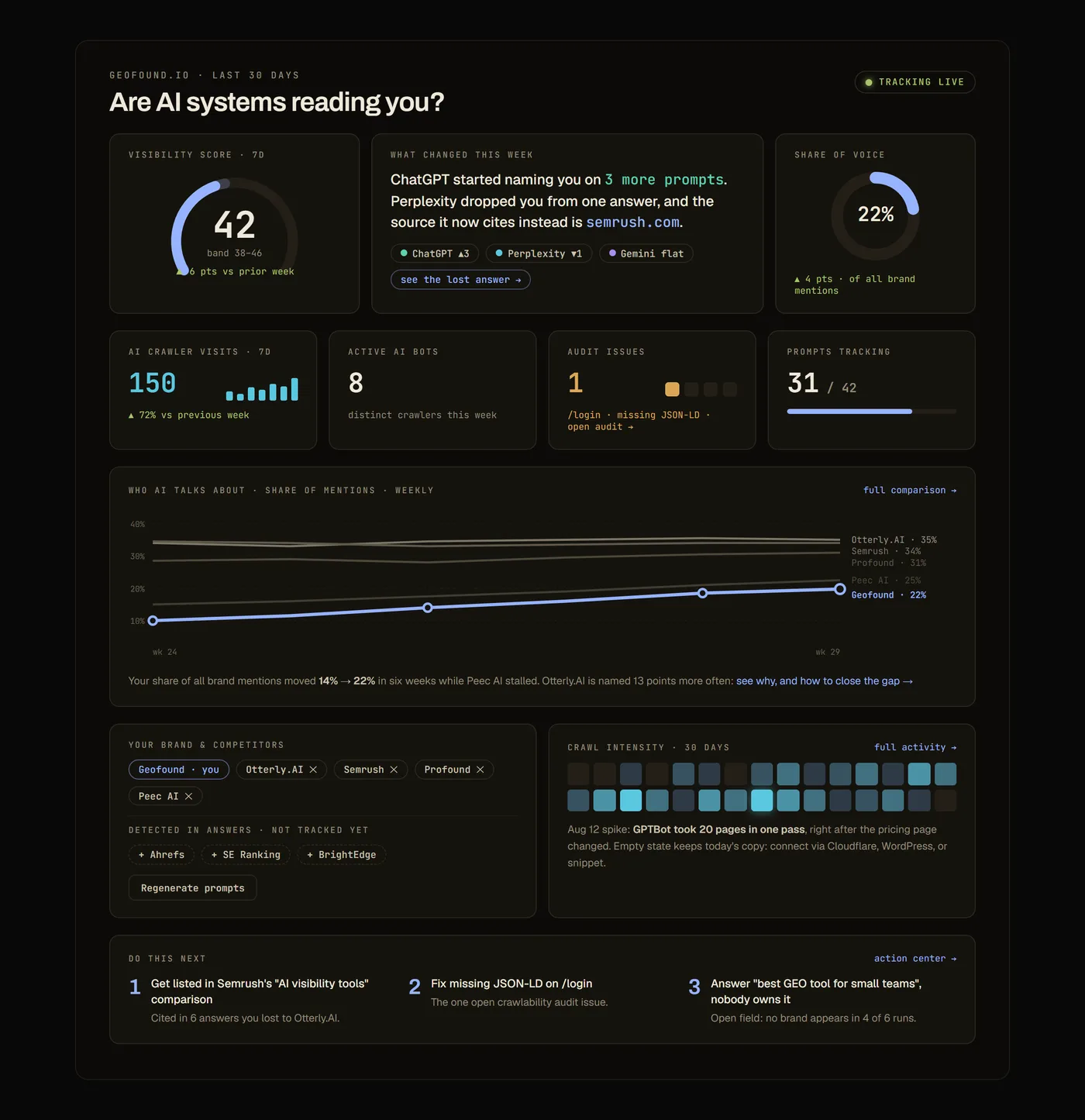
Start by finding out where you stand. The free scan is the one-minute version: three buyer questions, one engine, the names it returned. The full version, eight engines with the playbook attached, is Geofound. The alternatives are compared on this site, concessions included, if you want to read that first.
FAQ
Is GEO just SEO with a new name? No. They share a foundation and diverge above it. Search engine optimization targets your pages so they rank for queries. Generative engine optimization targets your presence across the sources assistants cite so you get recommended in answers. The Ahrefs correlation data is the clearest evidence they are not the same discipline, since backlinks were the weakest signal measured while unlinked brand mentions were the strongest.
What is the difference between GEO and AEO? In practice the terms are used interchangeably. Answer engine optimization usually emphasises being the quoted answer, and generative engine optimization usually emphasises being named in a synthesized recommendation. Both describe the same goal of getting your brand into AI answers, and neither is a Google-recognised category.
Should I publish an llms.txt file? Not for Google AI Overviews, which ignore it outright. It may help in agent tooling contexts. Do not expect it to change whether ChatGPT or Perplexity recommends you, and do not let it become the whole GEO strategy.
Does structured data help AI visibility? Google says it is not required for its generative features, which is not the same as saying it does nothing. Schema is cheap, it makes your product machine readable, and it has other benefits. Just do not expect it to be the reason an assistant starts recommending you.
How often should I check AI visibility? Weekly is enough for most brands, and judge the trend rather than any single day. Answers vary between runs, so one check tells you very little. That variance is the entire reason AI visibility measurement needs repeated sampling.
Citations (3)showhide
See who AI recommends in your category
The free scan asks ChatGPT three of your buyers' questions and shows whether you're in the answer, in about a minute.
Run the free scan →